
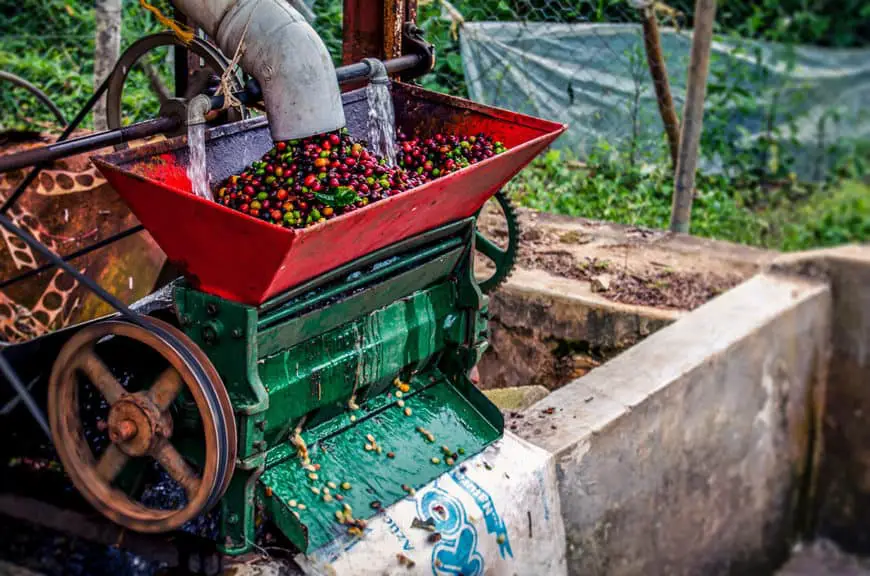

Walk into any specialty coffee shop in the United States and you will find a bag labeled Costa Rica Tarrazú. It will cost more than the house blend. The label will mention volcanic soil, high altitude and a clean, bright cup. All of that is true.
What the label will not tell you is that Tarrazú is a guarantee of origin, not of quality. It tells you where the coffee was grown — a mountain region covering tens of thousands of hectares and thousands of individual farms. It says nothing about whether the coffee in that particular bag is any good.
I spent years running coffee tours in Costa Rica, and this was the misunderstanding I ran into most. People treat “Tarrazú” as a promise of excellence. It is closer to “Napa Valley”: a protected name with a real reputation, covering everything from world-class to entirely forgettable.
This guide covers what the region actually is, what the name legally guarantees, what drives quality within it, and how to read a Tarrazú bag so you can tell the difference.
Where Tarrazú actually is
Tarrazú sits in the mountains southeast of San José, in the Pirrís river basin, and it is the best known of Costa Rica’s coffee regions (our Costa Rican coffee guide covers the others). Locally it is called Los Santos — the Saints — because the main towns of its three cantons are named for them: San Marcos in Tarrazú, San Pablo in León Cortés and Santa María in Dota. Ask someone in San José about “Tarrazú” and they will think of the drive: about two hours, steadily climbing, coffee on every slope steep enough to hold a tree.
Tarrazú at a glance
The specs every roaster page repeats — here they are, so we can move on.
- LocationPirrís river basin, southeast of San José. Known locally as Los Santos.
- ProtectionDenominación de Origen since 2019, covering the Tarrazú, Dota and León Cortés cantons.
- AltitudeRoughly 1,200–1,900 m. Nearly all of it qualifies as Strictly Hard Bean.
- OutputCosta Rica’s largest coffee region by volume — over a third of the national crop.
- Main varietiesCaturra and Catuaí, with growing plantings of Villa Sarchí, Geisha and F1 hybrids.
- HarvestRoughly November through March, peaking December–February.
- Farm sizePredominantly smallholders — many farms only a few hectares.
- Typical cupClean, bright acidity, medium body, chocolate and citrus notes.
That last line is where the trouble starts. “Clean, bright, chocolate and citrus” is a description of well-made Tarrazú. It is not a description of everything grown there.
What the name does — and doesn’t — guarantee
Since 2019, “Café de Tarrazú” has been a legally protected Denominación de Origen (DO) in Costa Rica, and the name has since been registered internationally through the World Intellectual Property Organization and with the European Union. Under the DO, only coffee from the three Los Santos cantons — Tarrazú, Dota and León Cortés — can carry the official seal.
That is real protection, and the farmers who fought for it deserve the credit. But look at what it covers: where the coffee grew. A DO certifies origin. It is not a cupping score. In practice the name also gets used more loosely than the DO intends — ICAFE, Costa Rica’s coffee institute, draws its Los Santos region more widely, taking in neighboring cantons such as Desamparados, Aserrí and Acosta — and the official DO seal still appears on relatively few bags.
Costa Rica also grades coffee by the hardness of the bean, which is a proxy for altitude. Strictly Hard Bean (SHB) means grown above roughly 1,200 meters. Because nearly all of Tarrazú sits above that line, nearly all of its coffee is technically SHB.
That is genuinely meaningful — slower cherry maturation at altitude does produce denser beans and more developed sugars. But it is a geographic classification, not a cup-quality one. A poorly picked, carelessly fermented, badly dried coffee grown at 1,500 meters in Dota is still SHB, still Tarrazú, and can still go in a bag with a mountain on it.
Add to this that Tarrazú is a blending designation as much as an origin. A large mill takes in cherry from hundreds of smallholders across the region. What comes out is a regional lot — an average. Averages can be very good. They are almost never exceptional, because exceptional requires separating things out rather than combining them.
- What it is
- Cherry from many farms, combined at a large mill and sold under the regional name.
- Traceability
- Region only. No farm, no producer, often no mill.
- Consistency
- High. Blending smooths out both faults and highlights.
- Ceiling
- Good, dependable coffee. Rarely memorable.
- Price
- Lower. This is most of what you see abroad.
- What it is
- One farm or small group, processed at their own mill, kept separate.
- Traceability
- Named farm or mill, often the variety and processing method too.
- Consistency
- Varies by lot and year — that is the point.
- Ceiling
- Very high. This is where the region’s reputation was actually built.
- Price
- Higher, and worth it if you care about the cup.
What actually drives quality in Tarrazú
Three things matter far more than the region printed on the bag.
1. Picking selectivity
This is the biggest single lever, and it is almost never discussed on packaging. Coffee cherries on the same branch do not ripen at the same time. A picker working carefully takes only the deep red, fully ripe cherries and returns to the same tree several times across the season. A picker working fast strips the branch — ripe, underripe, overripe, all into the same basket.

Underripe cherries taste green, grassy and astringent. Overripe ones ferment on the tree and bring sour, winey off-notes. No amount of skilled processing or roasting recovers a badly picked lot. If you have ever wondered why a coffee tastes sour or harsh when you did everything right at the brewer, picking is often where it started.
It is worth remembering who does this work. The Tarrazú harvest runs largely on migrant labor — many pickers are Nicaraguan, and many are Ngäbe-Buglé families who come from Panama for the season — and they are paid by the volume they pick. Selective picking takes longer and yields less per day. When you pay more for carefully picked coffee, that is a large part of what the money is for. I’ve written more about what a day of coffee picking actually looks like.
2. The micro-mill revolution
For most of the twentieth century, a Costa Rican smallholder had one option: deliver cherry to a large cooperative or private mill, get paid by weight, and watch it disappear into a regional blend. Quality was invisible. There was no way to be paid more for growing better coffee.
That changed after the coffee price crisis of the late 1990s. Around 2000, families in Tarrazú began building their own small processing mills — micro-beneficios. La Candelilla, run by the Sánchez siblings, is widely credited as the country’s first, and many more followed through the 2000s. Suddenly a family with five hectares could process its own cherry, keep its lots separate, experiment with honey and natural processing, and sell under its own name.
This is the real reason Tarrazú has the reputation it does. Not the soil, which is good but not unique in Costa Rica. The region became famous because its farmers gained control over how their coffee was processed and had a reason to care about quality.
3. Altitude — with a caveat
Altitude is real. Cooler temperatures slow cherry development, which builds sugar and acidity. A farm at 1,800 meters has a genuine advantage over one at 1,200.
But altitude is the easiest thing to put on a bag and the least within anyone’s control, which is exactly why marketing leans on it so heavily. It sets a ceiling; it does not determine where in the range the coffee lands. A meticulous producer at 1,300 meters will beat a careless one at 1,800 every time. For more on how growing conditions translate into flavor, see our guide to coffee terroir.
How to read a Tarrazú bag
Here is the practical part. Specific information signals that someone kept the lot separate and knows its history. Vague romantic language signals a regional blend dressed up.
- Named farm or mill
- “Don Mayo”, “La Candelilla”. Someone is willing to be accountable.
- Variety stated
- Caturra, Catuaí, Villa Sarchí, Geisha. Implies separated lots.
- Processing method
- Washed, honey, natural, anaerobic — a deliberate choice worth naming.
- Harvest year
- Tells you the crop is current, not warehouse stock.
- Specific altitude
- “1,650 m” rather than “high altitude”.
- DO Tarrazú seal
- Confirms the coffee came from the three Los Santos cantons. A useful origin check, not a quality score.
- Roast date
- Not origin-related, but the clearest sign a roaster is serious.
- “Tarrazú” alone
- Tells you the region at best. Not a specification.
- “SHB” alone
- Nearly all Tarrazú coffee is SHB. It does not distinguish.
- “Rich volcanic soil”
- True of much of Costa Rica. Pure copywriting.
- “Estate grown”
- Unregulated term. No defined meaning.
- “Gourmet” / “premium”
- No standard behind either word.
- “Best in the world”
- Every origin page says this.
Four common buying mistakes
It means the coffee grew in a particular region. Within that region the range runs from outstanding to ordinary. Judge the lot, not the label.
Some roasters charge single-origin prices for coffee traceable no further than “Tarrazú”. If nothing on the bag is more specific than the region, it is a regional lot.
Whatever the origin, coffee ground weeks ago has lost the aromatics you paid extra for. A regional lot bought fresh and ground at home beats a famous farm bought stale.
Tarrazú’s appeal is clean acidity and clarity. A dark roast removes exactly those qualities. If the beans are oily and near-black, you are tasting roast, not origin.
Names worth knowing
If you want to explore beyond regional lots, these are names worth recognizing on a bag. A canton narrows down the origin; a named micro-mill tells you the lot was kept separate.
- San Marcos de Tarrazú — the commercial center of the region and home of CoopeTarrazú, the area’s largest cooperative.
- Santa María de Dota — home of CoopeDota, one of the country’s best-known cooperatives, with a long record of traceable lots.
- San Pablo de León Cortés — the third canton of Los Santos, dense with small producers and micro-mills.
- La Candelilla — the Sánchez family’s micro-mill in Tarrazú, widely credited as Costa Rica’s first.
- Don Mayo — the Bonilla family’s micro-mill, with farms in León Cortés reaching close to 2,000 meters.
- Puente Tarrazú — a micro-mill founded in 2004 by a group of neighboring León Cortés producers.
Seeing any named micro-mill is the strongest quality signal you will find on a Costa Rican bag.
Seeing it yourself
If you are in Costa Rica during harvest — roughly December through February — Los Santos is a straightforward day trip from San José. The drive climbs through Cartago and into the mountains, and by the time you reach San Marcos you are surrounded by coffee.
Several mills and cooperatives run tours, and harvest season is by far the best time: the depulpers are running, the drying patios are full, and pickers are working the slopes. Outside harvest the landscape is beautiful but quiet, and you will see equipment rather than process. If you are planning a trip around coffee, our guide to coffee tourism has more ideas.
Bring cash, expect Spanish to be useful, and note that mornings are clear while afternoons cloud over quickly at altitude — worth planning around if you want photographs.
So is Tarrazú coffee good?
Yes — the reputation is earned. The altitude is real, the varieties suit the conditions, and the micro-mill movement gave a generation of producers both the tools and the incentive to chase quality.
But the name on the bag is a starting point, not a verdict. The difference between a forgettable regional blend and a genuinely excellent Tarrazú is not the region they share — it is picking, processing, and whether anyone bothered to keep that lot separate and put their name on it.
Look for a farm name. Look for a variety. Look for a roast date. If the most specific thing on the bag is the region itself, you are buying an average — a decent one, but an average.
Once you have good beans, the rest is up to you: our coffee brew calculator will get your ratio right, and the flavor wheel guide will help you put words to what you are tasting.
Former roastery owner and coffee tour operator. Steve spent five years roasting coffee for his own shop and wholesale customers. More about Steve