
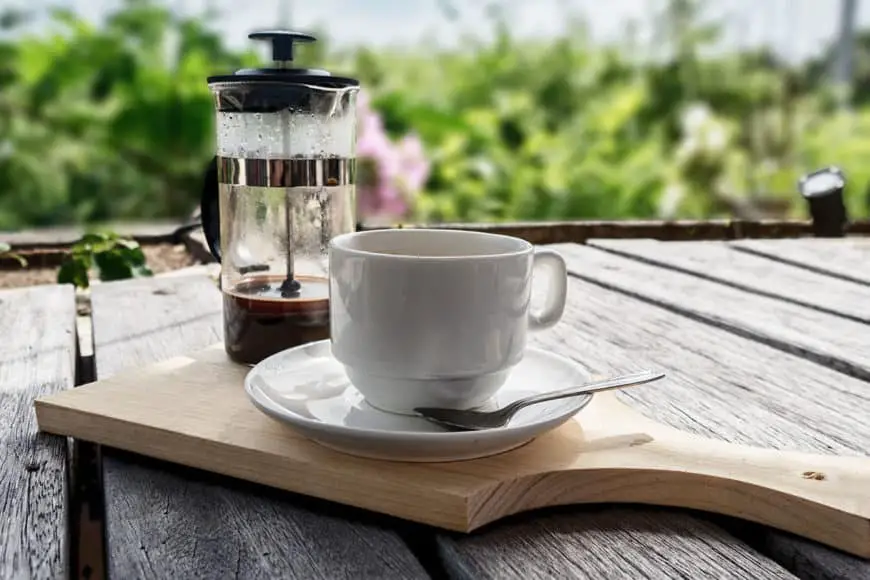
The French press is the simplest way to make a rich, full-bodied cup of coffee at home. There is no paper filter, no machine and almost nothing to go wrong: you steep coarse coffee in hot water, press a mesh filter down, and pour. Get the grind, ratio and timing right and it will make one of the best cups of coffee you have ever had.
How a French Press Works
The French press, in one sentence
A French press is an immersion brewer: coarse coffee steeps directly in hot water for about four minutes, then a metal mesh filter attached to a plunger pushes the grounds to the bottom so you can pour off the coffee.
- Immersion: every ground sits in the water the whole time, so extraction is even and forgiving.
- Metal filter: lets the coffee’s natural oils and fine particles through, which is why the cup feels so full and rich.
- Result: heavy body, low acidity, deep chocolate and nutty flavors.
That metal filter is the big difference from drip and pour-over brewers, which use paper that traps oils and gives a lighter, cleaner cup. Our guide to immersion vs pour-over brewing explains the trade-off in detail.
Parts of a French Press
- Knob: the handle you push to lower the filter.
- Plunger rod: connects the knob to the filter.
- Lid: holds in heat and keeps the plunger centered.
- Filter assembly: a mesh screen sandwiched between a spiral plate and a cross plate, screwed to the rod.
- Carafe: the glass, steel or ceramic beaker that holds the coffee.
- Frame and handle: protect the carafe and let you pour safely.
The filter assembly is the part that matters most. If the mesh is bent, torn or clogged with old grounds, grit slips past the edges and ends up in your cup, so it is worth unscrewing and cleaning it regularly.
How to Use a French Press, Step by Step
French press for two mugs
30 g coarse coffee, 480 g (about 16 oz) water at 200°F (93°C). About 5 minutes.
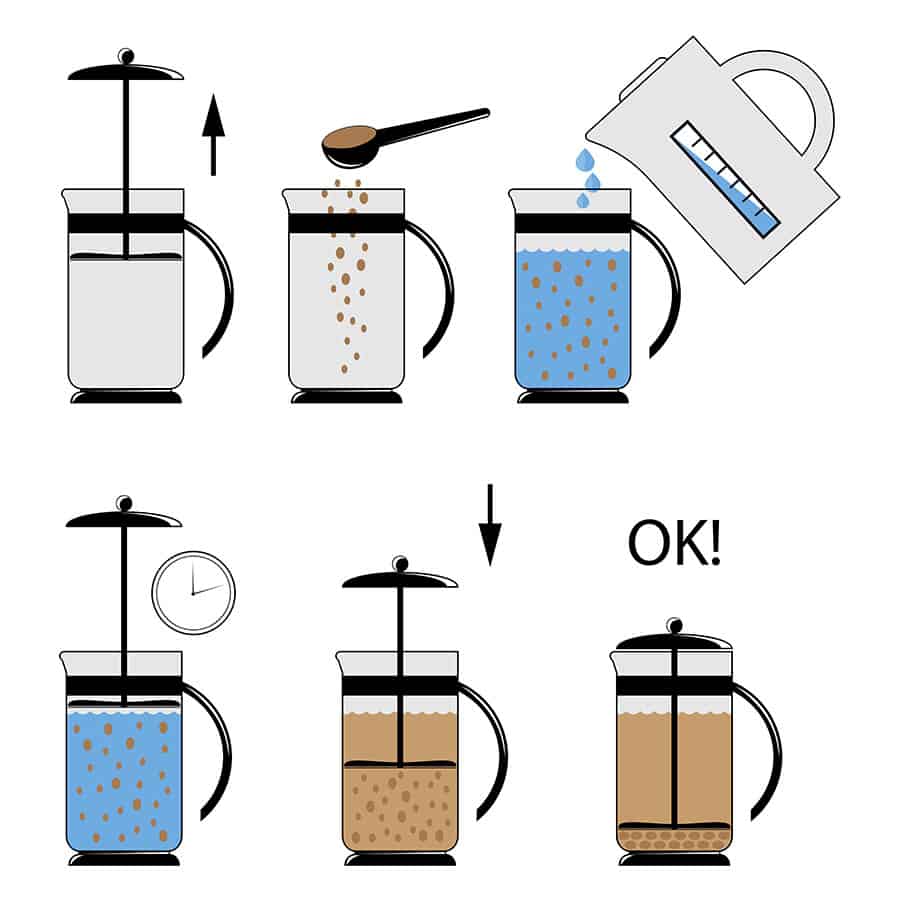
- Heat the water to just off the boil. Pour a little into the empty press to warm it, then discard.
- Grind 30 g of coffee coarse, like sea salt, and add it to the press.
- Start a timer and pour in about 60 g of water to wet all the grounds. Let it bloom for 30 seconds.
- Pour in the rest of the water, give it a gentle stir, and put the lid on with the plunger pulled all the way up.
- Steep until the timer reads 4:00.
- Press the plunger down slowly and steadily, taking about 20 seconds. If it resists hard, your grind is too fine.
- Pour all the coffee out right away, into mugs or a carafe, so it stops brewing.
French Press Ratio and Grind
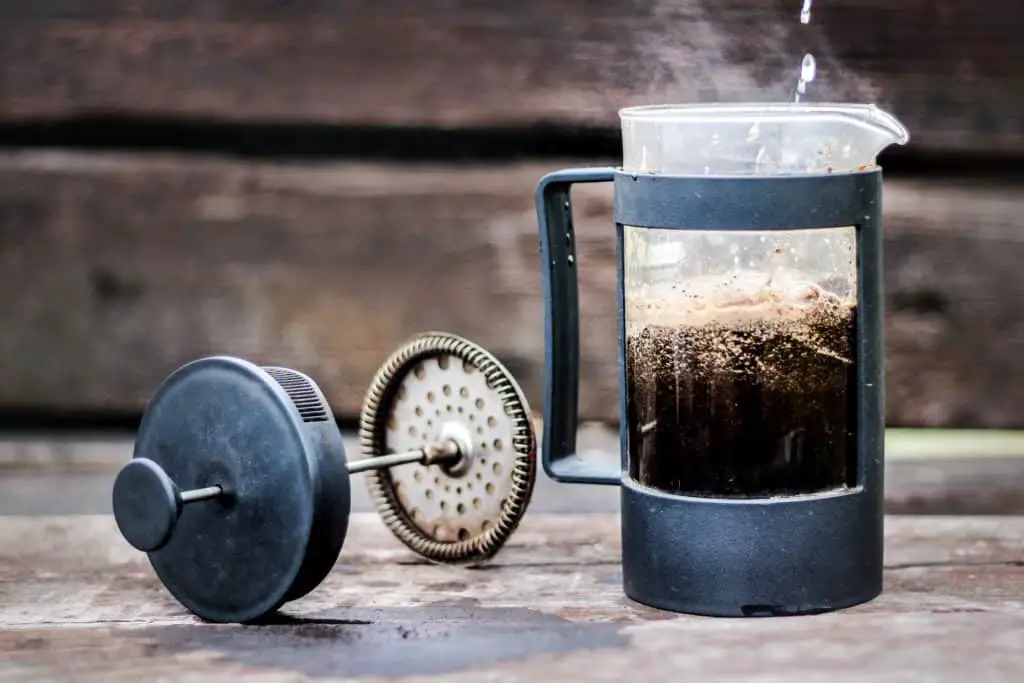
A ratio of about 1:16, one gram of coffee for every 16 grams of water, is the classic starting point. Go to 1:14 or 1:15 for a stronger cup, or 1:17 for something lighter. The grind should be coarse and even; fine grounds over-extract into bitterness and slip through the mesh as sludge.
- Coffee
- 15 g (about 2 tbsp)
- Water
- 240 g (8 oz)
- Coffee
- 30 g (about 4 tbsp)
- Water
- 480 g (16 oz)
- Coffee
- 60 g (about 8 tbsp)
- Water
- 960 g (32 oz)
Our grind size guide shows exactly what coarse looks like, and a burr grinder makes a big difference here; see blade vs burr grinders for why.
Want the numbers on your counter? Our printable Coffee-to-Water Ratio Guide gives the proven ratio, grind and water temperature for the French press and seven other brew methods, with a one-page kitchen chart.
Common French Press Mistakes
Fine coffee turns bitter, makes the plunger hard to push and leaves sludge in the cup. Go coarse.
The grounds keep brewing even after you press. Pour everything out as soon as you are done, or the last cup will be bitter.
Forcing the plunger stirs up fines and can spray hot coffee. A slow, steady 20-second press is enough.
Water straight off a rolling boil scorches the grounds. Let it sit for about 30 seconds first.
Old coffee oils turn rancid and taint every new batch. Take the filter apart and wash it regularly.
If your coffee still tastes off, our guide to why coffee tastes bitter, sour or weak walks through the fixes.
Types of French Press
- Best for
- Watching the brew; the classic look
- Watch out
- Fragile, and loses heat fastest
- Best for
- Durability; double-wall models keep coffee hot
- Watch out
- You cannot see inside
- Best for
- Good heat retention and a handsome table piece
- Watch out
- Heavy and breakable
- Best for
- Brewing in the mug you drink from
- Watch out
- Small capacity, harder to clean
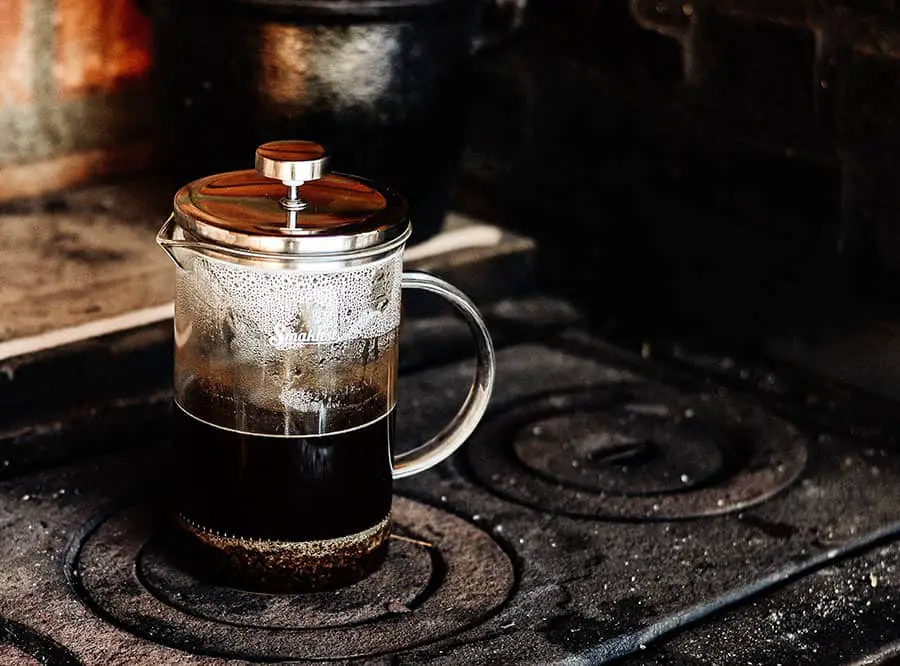
For most people, a double-wall stainless steel press is the best all-round choice: it will not break, keeps coffee hot through a second cup, and lasts for years. A borosilicate glass press is the budget pick. Wondering how the French press compares to other brewers? See French press vs drip, Chemex vs French press, French press vs AeroPress and French press vs moka pot. It also makes excellent cold brew.
How to Clean a French Press
Scoop or shake the spent grounds into the trash or compost rather than the sink, since coffee grounds clog drains. Rinse the carafe and plunger with hot water after every use. Once a week, unscrew the filter assembly, wash each piece with warm soapy water, and reassemble it. If oils have built up, soak the parts in a mix of warm water and a little white vinegar or baking soda. More tips are in our guide to cleaning a coffee maker.

Former roastery owner and coffee tour operator. Steve spent five years roasting coffee for his own shop and wholesale customers. More about Steve