
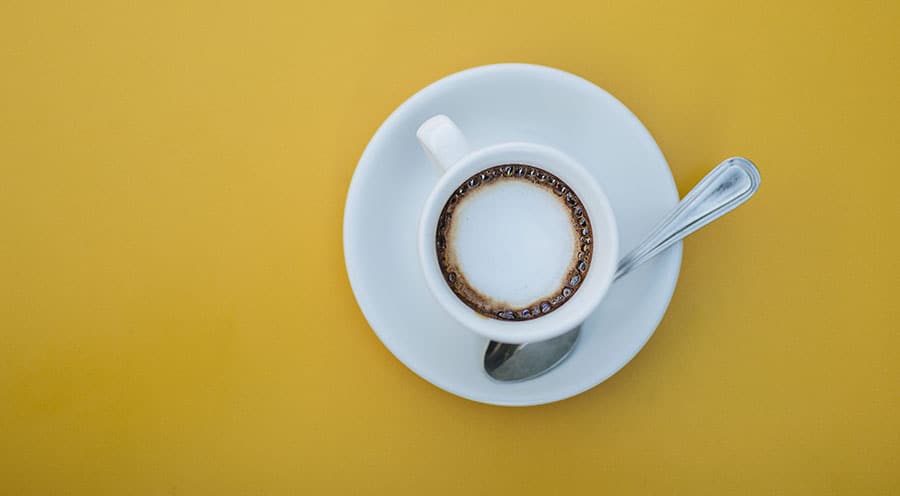
A macchiato, or espresso macchiato, is a shot of espresso “marked” with a small spoonful of milk foam. It is a small, strong drink, usually 1 to 3 oz, served in a demitasse cup. Macchiato is Italian for “stained” or “marked”: the dab of foam stains the espresso, softening its edge without hiding its flavor. It is not the same as a Starbucks-style caramel macchiato, which is a large, sweet vanilla latte with espresso poured on top and caramel drizzled over it.
| Drink | Espresso | Milk | Typical size |
|---|---|---|---|
| Espresso macchiato | Single or double shot | A spoonful of foam | 1 to 3 oz, demitasse |
| Cortado | Double shot | About equal steamed milk, little foam | 4 to 4.5 oz, small glass |
| Cappuccino | Single or double shot | Steamed milk and a thick layer of foam | 5 to 6 oz, cup |
| Latte macchiato | Single or double shot, poured last | Mostly steamed milk, layered | 8 to 12 oz, tall glass |
| Caramel macchiato | Double shot, poured last | Steamed milk with vanilla syrup, caramel drizzle | 12 oz or more |
Sizes vary from café to café. A macchiato has the same caffeine as the espresso in it: about 64 mg for a single shot and 128 mg for a double.
What Does Macchiato Mean?
Macchiato (mah-kee-AH-toh) means “stained,” “spotted” or “marked” in Italian. In Italy you order a caffè macchiato, coffee marked with milk. The usual explanation is practical: baristas added a spot of foam to tell an espresso with a little milk apart from a plain espresso. The drink grew up with Italian espresso bars in the 20th century, and Italians still drink it as a quick, strong coffee at the counter.
In Italy you may hear two versions: a macchiato caldo, marked with hot foamed milk, and a macchiato freddo, marked with a splash of cold milk. Outside Italy, “macchiato” almost always means the hot, foam-marked version.
What Does a Macchiato Taste Like?
A macchiato tastes mostly like espresso: rich, intense and slightly bitter, with a little sweetness and creaminess from the foam. It is far stronger-tasting than a latte or cappuccino because there is so little milk. It is not sweet unless you add sugar. If straight espresso is a bit much for you but a latte feels too milky, a macchiato or a cortado is the natural middle ground. Our cortado guide also compares the cortado and macchiato in detail.
How to Make an Espresso Macchiato
Espresso macchiato (one cup)
About 3 minutes. Serve in a warmed demitasse cup.
- 18 g finely ground espresso coffee
- About 3 oz (90 ml) cold whole milk
- Sugar, optional
- Pull the shot. Brew a double espresso, about 36 g of liquid in 25 to 30 seconds, straight into a warmed demitasse. For a single macchiato, use a single shot.
- Steam a little milk. Steam the milk to 140 to 155°F, stretching it just enough to make a fine, glossy microfoam. You only need a spoonful, but a small amount of milk is easier to steam well.
- Mark the espresso. Spoon 1 to 2 teaspoons of foam onto the center of the crema, or pour a small dot from the pitcher. The espresso should still show around the edge.
- Drink it right away, while the crema and foam are fresh. See how long a fresh espresso shot lasts.
No espresso machine? Make strong coffee in a moka pot and froth a little warm milk with a handheld frother or a French press. It will not have true crema, but it makes a good home version. Our guide on how to froth milk covers every method.
Espresso Macchiato vs Latte Macchiato
These are two very different drinks. An espresso macchiato is espresso marked with a little milk. A latte macchiato is the reverse: a tall glass of steamed milk “marked” by espresso poured in last, which forms distinct layers of milk, coffee and foam. It is milder and creamier than a regular latte, because the espresso is not mixed in at the start.
- Steam about 8 oz (240 ml) of milk to 140 to 155°F with a generous layer of foam.
- Pour the milk into a tall glass and let it settle for a few seconds.
- Pour a single or double shot of espresso slowly through the foam. It will settle between the milk and the foam to form a layer.
What Is a Caramel Macchiato?
The caramel macchiato was made famous by Starbucks in the 1990s and is the drink most Americans picture when they hear “macchiato.” It is really a sweetened latte macchiato: vanilla syrup, steamed milk, espresso poured on top and a crosshatch of caramel sauce.
- Add 1 tablespoon (½ oz) of vanilla syrup to a 12 oz cup.
- Steam 8 oz of milk and pour it in, holding back a little foam, then spoon the foam on top.
- Pour a double shot of espresso slowly over the foam.
- Drizzle caramel sauce over the top in a crosshatch.
Iced caramel macchiato: fill a glass with ice, add the vanilla syrup and 6 oz of cold milk, pour the espresso over the top, then drizzle with caramel. Our guide to coffee syrups covers the best vanilla syrups and how to make your own.
Macchiato vs Cortado, Cappuccino and Latte
- Macchiato vs cortado: a cortado has about as much milk as espresso, so it is larger, smoother and milder. A macchiato has only a spoonful of foam and tastes almost like straight espresso. See what is a cortado for a full comparison.
- Macchiato vs cappuccino: a cappuccino has several ounces of steamed milk and a thick cap of foam; a macchiato has just a dab.
- Macchiato vs latte: a latte is mostly steamed milk with a thin layer of foam, much milder and larger. See latte vs cappuccino.
Tips for a Better Macchiato
- Use good espresso. With so little milk, the coffee is everything. A chocolatey medium roast or a classic espresso blend works best.
- Keep the milk to a spoonful. More milk turns it into a cortado or a small cappuccino.
- Try plant milks. Oat milk foams best and tastes closest to dairy; barista versions of almond and soy milk also work. See our guide to the best milks for coffee.
- Order it right. In Italy, ask for “un caffè macchiato.” In American chains, ask for an “espresso macchiato” so you do not get a caramel macchiato.
- Drink it any time. The Italian habit of skipping milky coffee after late morning applies mainly to cappuccino. A macchiato, with its small splash of milk, is a common after-lunch coffee in Italy.
Former roastery owner and coffee tour operator. Steve spent five years roasting coffee for his own shop and wholesale customers. More about Steve