


Melitta Bentz (1873 to 1950) was a German housewife and entrepreneur from Dresden who invented the paper coffee filter in 1908. Tired of bitter coffee full of grounds, she punched holes in the bottom of a brass pot, lined it with a sheet of blotting paper from her son’s school notebook, and poured hot water over the ground coffee. The paper caught the grounds and let clean coffee drip through: the first paper-filter pour-over. She registered the design with the Imperial Patent Office in Berlin on 20 June 1908, founded her company that December with a starting capital of just 72 pfennigs, and the Melitta company she started is still one of the biggest names in coffee filters today.
| Full name | Amalie Auguste Melitta Bentz, born Liebscher |
| Born | 31 January 1873, Dresden, Germany |
| Died | 29 June 1950, Holzhausen, near Minden, Germany |
| Invention | The paper coffee filter: a perforated brass cup lined with blotting paper |
| Registered | 20 June 1908, Imperial Patent Office, Berlin (as a utility model) |
| Company | Registered 15 December 1908 in Dresden; moved to Minden in 1929 |
| Legacy | Paper filter pour-over and drip coffee; the Melitta brand |
Who Was Melitta Bentz?
Melitta Bentz was born Amalie Auguste Melitta Liebscher in Dresden on 31 January 1873; her father was a publisher. Around 1898 she married Hugo Bentz, a businessman, and the couple had three children: sons Willy (born 1899) and Horst (born 1904) and a daughter, born in 1911. Like many households at the time, the family made coffee at home every day, and that daily routine led to her invention.
What Did Melitta Bentz Invent?

Melitta Bentz invented the paper coffee filter. In the early 1900s, coffee in German homes was usually boiled with the grounds or strained through cloth or metal sieves. Boiled coffee was bitter and gritty, cloth filters were hard to keep clean, and metal sieves let fine grounds through. Percolators, which pass boiling coffee through the grounds again and again, also tended to over-extract it.
Bentz’s solution was simple. She punched holes in the bottom of a brass cup, laid a piece of blotting paper from her son Willy’s school exercise book inside it, added ground coffee and poured hot water over it. The coffee dripped through clean, without grounds and with less bitterness, and the used paper and grounds could simply be thrown away. On 20 June 1908, the Imperial Patent Office in Berlin registered her design as a utility model (Gebrauchsmuster), a kind of short-term patent, describing it as a coffee filter with a curved, recessed base and angled flow holes. It is often called her patent.
Did Melitta Bentz Invent the First Coffee Filter?
Not the first filter of any kind, but the first paper one. People had strained coffee through cloth bags and metal strainers since at least the 1700s, and cloth filters are still used in brewers such as Costa Rica’s chorreador. What Melitta Bentz invented was the disposable paper filter and the filter holder to use it with, the basis of nearly every paper pour-over and drip coffee maker since. Compare the options today in paper, metal or cloth coffee filters.
How Melitta Bentz Built Her Company
Bentz turned her invention into a business straight away, starting from a room in the family’s Dresden apartment. Her husband Hugo and their sons worked in the business, and she led the marketing.
- 1908: the company, at first called M. Bentz, is entered in the Dresden commercial register on 15 December with a starting capital of 72 pfennigs.
- 1909: the filters sell well at the Leipzig Trade Fair, with more than 1,200 sold.
- 1910: an improved filter lets coffee drip straight into a jug or pot.
- World War I: Hugo is drafted, coffee imports stop and the company survives by making cartons; Melitta’s brother Paul Liebscher helps keep it running.
- 1920s: the company grows quickly. Son Willy becomes a co-owner in 1923, and the red-and-green packaging appears in 1925 to set the brand apart from imitators. By 1928 it has about 80 employees.
- 1929: short of space, the company moves from Dresden to Minden in northwest Germany, where it is still based.
- 1932: Melitta and Hugo step back and hand the business to their sons.
- 1930s: the filter takes on the tapered, cone-like shape still used today, and the company patents its filter bags.
Bentz was also known as a progressive employer for her time. The company offered a Christmas bonus, up to three weeks of paid vacation and, later, a five-day working week, and in 1938 it set up a social fund for employees, Melitta-Hilfe.
Melitta During the Nazi Era
The company’s history has a darker chapter. After Melitta and Hugo handed control to their sons, the company sought closeness to the Nazi regime, and Horst Bentz joined the Nazi Party and the SS. During World War II, coffee filter production stopped and the factory made goods for the war effort, and the company used forced labourers. Filter production restarted after the war, in 1948. Melitta Bentz died on 29 June 1950 in Holzhausen, near Minden, at the age of 77.
Melitta Bentz’s Legacy
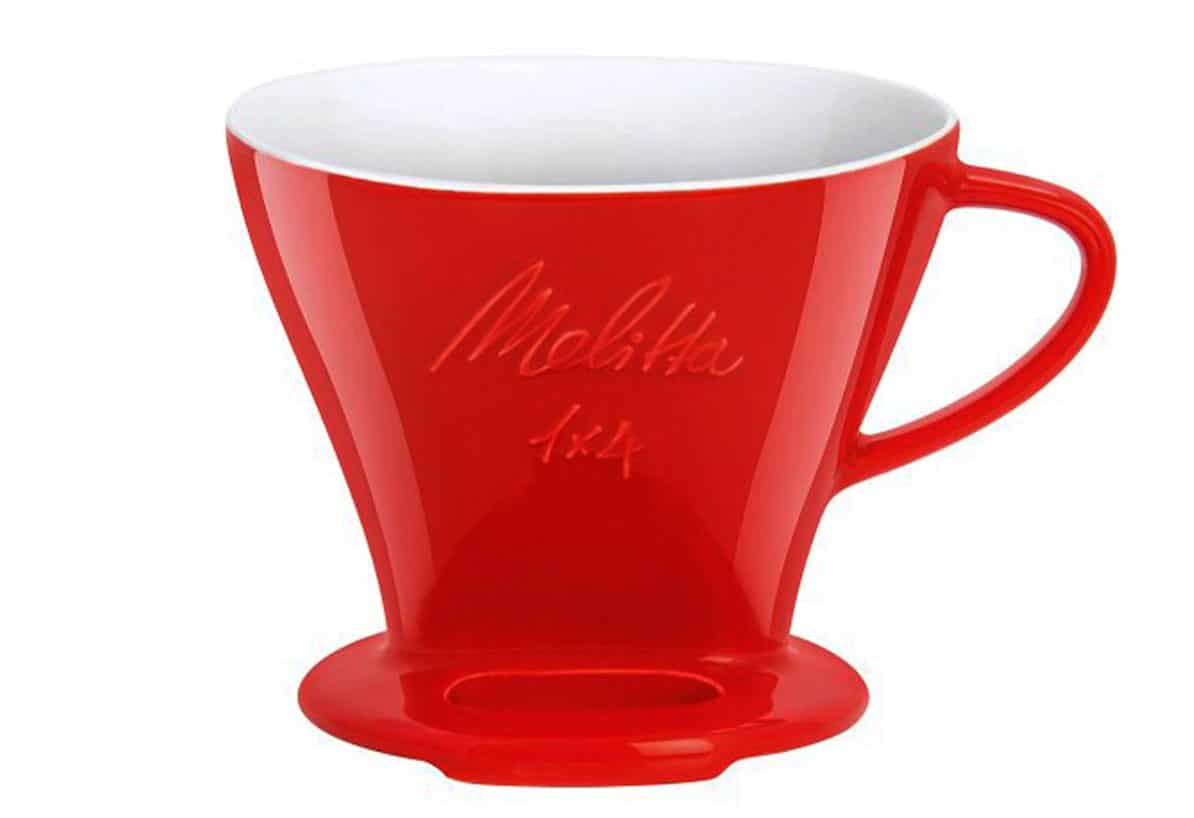
More than a century later, the paper filter is everywhere. Automatic drip coffee makers, Melitta’s own cone brewers and filters, and modern pour-over brewers such as the Hario V60, Kalita Wave and Chemex all use the same basic idea: hot water poured over ground coffee in a paper filter. Paper filters trap fine grounds and most of the coffee’s oils, giving a clean, bright cup, and they also hold back cafestol, a compound in coffee oils that can raise cholesterol.
The Melitta company, still family-owned and based in Minden, has grown into an international group that makes coffee filters, coffee makers, coffee and household products. Melitta Bentz is now often named among the most important women inventors, and her story is a reminder that one of coffee’s biggest changes started at a kitchen table. Read more in our history of coffee and history of the coffee house.
Brew Coffee the Melitta Way
To try her method at home, use a Melitta-style cone, a paper filter, about 20 g of medium-ground coffee and 320 g of water at 200 to 205°F. Rinse the filter, wet the grounds with a little water to let them bloom for 30 seconds, then pour the rest slowly and let it drip through. See our step-by-step Melitta pour-over brewer guide and the full pour-over coffee guide.

Former roastery owner and coffee tour operator. Steve spent five years roasting coffee for his own shop and wholesale customers. More about Steve