
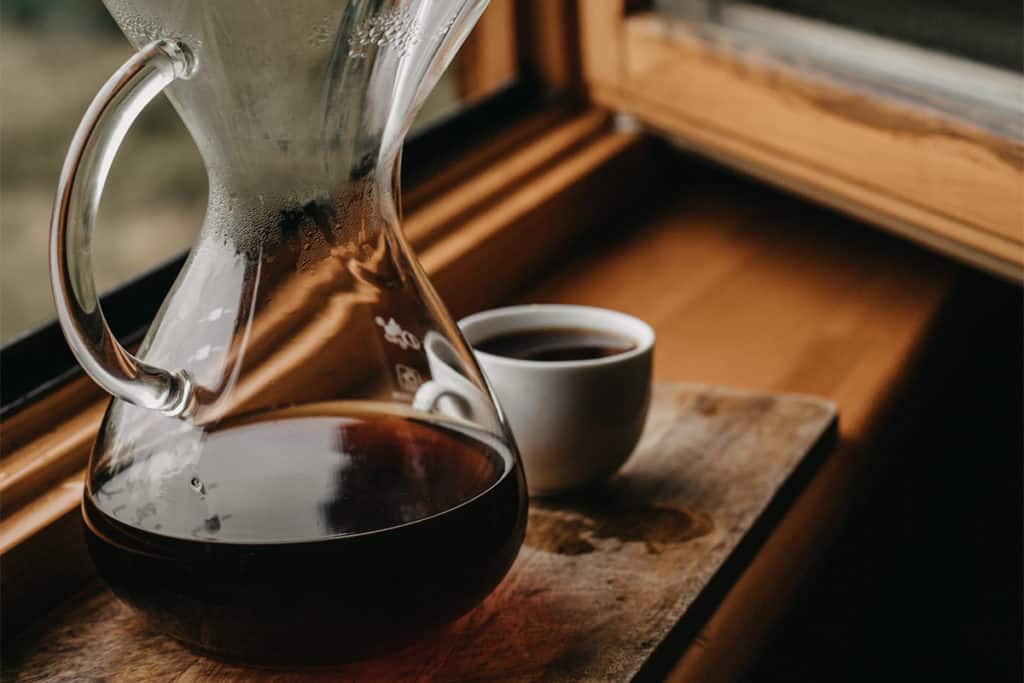
Flash-chilled iced coffee is hot coffee brewed straight onto ice. You swap part of the brewing water for ice in the carafe, so the coffee cools within seconds and finishes at normal strength instead of tasting watered down. It takes about five minutes with any pour-over dripper, and it keeps the bright, aromatic flavors that cold brew tends to mute.
You may also see it called flash brew or Japanese-style iced coffee. Same method, different names. Here is the recipe, how to scale it, and how it compares with cold brew.
| Item | Amount |
|---|---|
| Coffee | 30 g |
| Hot water | 330 g at 200–205°F |
| Ice in the carafe | 150 g, plus fresh ice for the glass |
| Overall ratio | 1:16, counting the ice as water |
| Grind | Medium, a notch finer than you use for hot pour-over |
| Brew time | About 3:30–4:00 |
| Makes | About 15 oz before serving |
What You Need
- A pour-over dripper and paper filter: a Chemex, Hario V60 or Kalita Wave all work
- A heatproof carafe or server to hold the ice (a Chemex is its own carafe)
- A digital scale and a timer
- A burr grinder, for an even grind
- A kettle, ideally a gooseneck for controlled pours
- 30 g of coffee, 330 g of water and about 200 g of ice
How to Make Flash-Chilled Iced Coffee
The trick is simple: the ice in the carafe is part of your brewing water. You pour less hot water than usual, so the coffee comes out concentrated and lands on the ice at the right strength.
Flash-chilled iced coffee in seven steps
30 g coffee · 330 g hot water · 150 g ice · about 4 minutes
- Heat the water to 200–205°F, or let it sit about 30 seconds off the boil.
- Rinse the filter with hot water and pour the rinse water away before any ice goes in.
- Add 150 g of ice to the carafe, set the dripper on top and put it all on the scale.
- Add 30 g of coffee, ground a notch finer than usual. Give it a gentle shake to level the bed, then tare the scale.
- Bloom with 60 g of water and wait 30–45 seconds.
- Pour the remaining 270 g in three pours of 90 g, 10–15 seconds apart. It should finish draining around 3:30–4:00.
- Swirl the carafe until the last of the ice melts, then pour over fresh ice and serve.
Why grind finer? With less hot water passing through the coffee, a normal grind under-extracts and tastes thin and sour. Going one or two notches finer makes up for the shorter contact. If it tastes harsh or drying, go back a notch.
Scale the Recipe
| Coffee | Hot water | Ice in carafe | Makes about |
|---|---|---|---|
| 20 g | 220 g | 100 g | 10 oz |
| 30 g | 330 g | 150 g | 15 oz |
| 45 g | 495 g | 225 g | 22 oz |
Every row is 1:16 with ice counted as water, and ice is about a third of the total. The grounds hold back roughly twice their weight in water, which is why you get less than you pour. For stronger coffee, try 1:15 by adding a few grams of coffee.
Tips for Better Flash-Chilled Coffee
That is how iced coffee ends up watery. The ice has to come out of the brewing water, not get added on top of it.
Too little and the coffee stays lukewarm, then melts the ice in your glass. About a third of the total water works well.
Flash-chilling shows off fruit and floral notes, so light and medium roasts from places like Ethiopia or Kenya shine. Very dark roasts can taste flat and bitter cold.
It tastes best within an hour or two. It keeps in the fridge for a day, but the aromatics fade.
Sugar dissolves poorly in cold coffee. Stir it into the ice in the carafe before you brew, or use simple syrup.
Any pour-over method works for this. A Chemex gives a very clean, light-bodied cup, while a V60 or Kalita Wave gives a bit more body.
Flash-Chilled vs Cold Brew vs Regular Iced Coffee
| Method | How it’s made | Time | Flavor |
|---|---|---|---|
| Flash-chilled | Brewed hot straight onto ice | About 5 minutes | Bright, aromatic, clean |
| Cold brew | Coarse grounds steeped in cold water | 12–24 hours | Smooth, low acidity, chocolatey |
| Regular iced coffee | Normal hot coffee poured over ice or chilled later | Varies | Often watery or stale |
Cold brew never touches hot water, so it pulls out fewer acids and aromatic compounds. That makes it smooth and mellow, and it keeps in the fridge for days, which suits batch brewing. Flash-chilled coffee goes the other way: hot water extracts the full range of flavors, and chilling it right away locks them in. If you like the taste of a good hot pour-over, flash-chilled is the closest iced match.
Cold brew often tastes stronger, but that comes from the recipe rather than the steeping. Concentrate is usually made at 1:4 to 1:6 and then diluted, which still puts far more coffee in each glass than a 1:16 flash brew. For more on the trade-offs, see our guide to cold brew vs iced coffee.
What About Snapchilled Coffee?
Snapchilled coffee is a commercial take on the same idea. The coffee is brewed hot as usual, then chilled to fridge temperature in about a minute by a stainless-steel heat exchanger instead of ice. Nothing is diluted, and the coffee has little time to go stale. The process was developed by MIT-trained engineer David Dussault. The machines are built for roasters and canning lines, not kitchens, so snapchilled coffee is something you buy in a can rather than make at home. Flash-chilling over ice, above, is the home version, and it gets you most of the way there.
Flash-Chilled Coffee FAQ
Is flash-chilled coffee the same as Japanese iced coffee?
Yes. Japanese iced coffee, flash brew and flash-chilled coffee all describe brewing hot coffee directly onto ice, with the ice counted as part of the water.
Does flash-chilled coffee have more caffeine than cold brew?
Usually not. Hot water extracts caffeine more efficiently, but a glass of cold brew made from concentrate contains much more coffee. The amount of coffee per cup matters more than the method.
Can I use an AeroPress?
Yes. Brew a strong cup with about 15 g of coffee and 150 g of hot water, then press it straight onto about 100 g of ice. That is roughly 1:17 overall. Grind a little finer than usual, as you would for pour-over.
Former roastery owner and coffee tour operator. Steve spent five years roasting coffee for his own shop and wholesale customers. More about Steve