
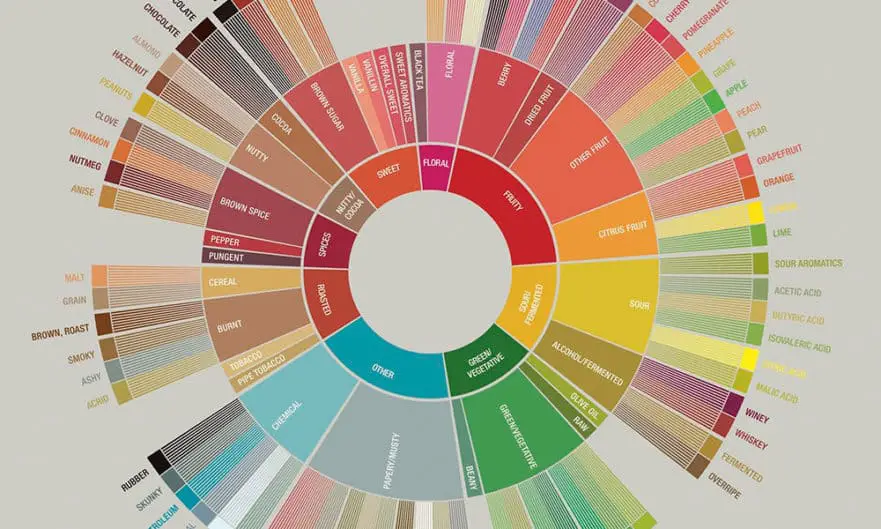
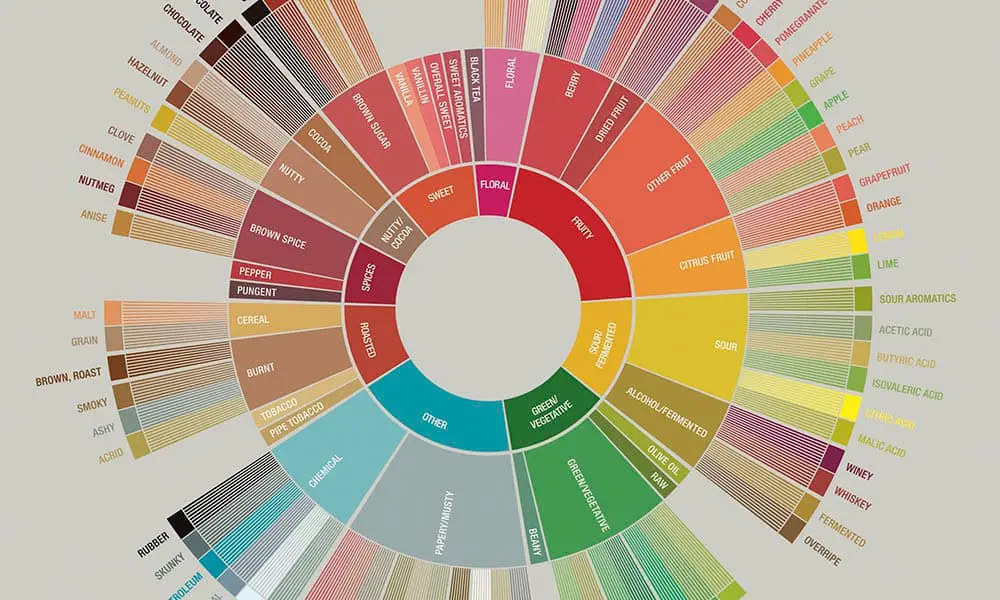
Coffee tasting notes can feel like fiction. One bag says strawberry jam, the next says bergamot and leather, and your cup tastes like… coffee. The flavor wheel is useful because it gives you a method for naming what you actually taste without forcing poetic nonsense. This guide shows you how to use it to brew better, buy smarter, and describe flavor in a way that holds up.
What the flavor wheel is really for
The flavor wheel isn’t there to impress anyone. It’s a structure that helps you move from vague reactions like bright, harsh, or smooth into descriptions that are specific enough to be useful. Think of it as a map for turning sensations into words you can repeat and compare.
The wheel isn’t a menu of notes to hunt for. It’s a map for moving from vague to specific.
Instead of saying:
- “This is good”
- “This is weird”
- “It’s strong”
- “It’s bright”
You learn to say:
- “It’s fruity, closer to citrus than berry”
- “The bitterness is cocoa-like, not burnt”
- “The acidity is tart like green apple, not sour like vinegar”
- “The finish is drying like black tea”
That’s useful. It helps you:
- dial in brewing (fix extraction problems faster)
- buy coffee you’ll actually like
- communicate clearly without sounding ridiculous
The one rule that makes tasting notes honest
Most bad tasting notes start with the label instead of the sensation. This section gives you the one simple rule that keeps you from inventing flavors: describe what your senses report first, then choose the closest word after.
Describe sensations, then attach a word.
If you start with the word (blueberry, jasmine, graham cracker), your brain will try to “find” it whether it’s there or not. If you start with the sensation (sweet, tart, floral, drying), the note you choose will usually be closer to the truth.
The 8-step method: broad to specific
If you want repeatable tasting notes, you need a repeatable process. This is a quick workflow that keeps you from jumping straight to outer-ring descriptors and helps you capture the same set of data every time.
Use this every time. It keeps you grounded.
1) Smell the dry grounds
Ask one question: What category is it?
- nutty/cocoa
- fruity
- floral
- spicy
- roasty/smoky
Don’t force it. If it’s just “coffee,” that’s fine.
2) Smell the wet grounds (or crust if you cup)
This is where fruit and floral often show up. Again: category first.
3) First sip: identify the “shape”
Pick one:
- bright and lively
- round and sweet
- heavy and chocolatey
- dry and tea-like
- roasty and intense
This is your anchor.
4) Acidity: name the type, not the hype
Acidity isn’t “high” or “low.” It has character.
Common types:
- citrus-like (lemon, orange)
- apple/pear-like (crisp, snappy)
- grape/berry-like (juicy, winey)
- tomato/vinegar-like (sharp, unpleasant — often a problem)
5) Sweetness: real, perceived, or missing?
Sweetness in coffee is subtle. Ask:
- Is there a sugary sweetness?
- A honey sweetness?
- A caramel sweetness?
- Or does it feel hollow/flat?
Sweetness is often what disappears first when a coffee is under-extracted or brewed with water that’s not helping you.
6) Bitterness: cocoa or ash?
Bitterness is not automatically bad. Separate these:
- cocoa/dark chocolate bitterness (can be pleasant)
- burnt/ashy bitterness (usually roast or extraction trouble)
- medicinal bitterness (often unpleasant, sometimes defect-like)
7) Body and texture: what does it feel like?
Body is physical. Choose something simple:
- light like tea
- medium like milk
- heavy like cream
- silky
- syrupy
- drying (like black tea tannins)
8) Finish: what lingers?
After you swallow, what remains?
- sweetness
- cocoa
- fruit
- roast
- dryness
- nothing (short finish)
Now, and only now, use the flavor wheel to pick a more specific word.
How to use the wheel the right way
The wheel works best when you treat it like a funnel. You start broad in the center, then move outward only when you’re confident. This section shows you how to avoid overfitting your tasting notes and still end up with descriptions that mean something.
Start in the center with broad categories. Move outward only if you’re confident.
Example:
- You taste “fruit.”
Move to fruity → is it berry, citrus, stone fruit, tropical? - You choose “citrus.”
Move outward → lemon, orange, grapefruit?
If you’re not sure, stop at the inner ring. “Citrus-like acidity” is a great note. Forcing “pink grapefruit zest” doesn’t make you a better taster. It makes you a worse one.
Build a tiny home reference library
Your palate improves faster when it has anchors. You don’t need expensive aroma kits; you need a few real foods that you taste often enough to recognize. This section gives you a simple shortlist that trains your brain to identify acidity, sweetness, bitterness, and texture with less guesswork.
Pick a few items you can keep around and taste occasionally:
Acidity references
- lemon slice (sharp citrus)
- orange (round citrus)
- green apple (crisp)
- red grape (juicy)
Sweetness references
- honey
- brown sugar
- caramel candy
Bitterness references
- dark chocolate
- cocoa powder (taste a tiny pinch)
Texture references
- black tea (drying/astringent)
- whole milk (round body)
This isn’t about gourmet. It’s about giving your brain a stable comparison point.
The “don’t embarrass yourself” translation guide
A lot of confusion comes from poetic notes that don’t connect to real sensations. This section translates common tasting terms into what they typically mean in the cup, so you can write notes that are clear and defensible even if you keep them simple.
These are common coffee notes, translated into reality:
- Berry often means: sweet + juicy acidity, sometimes winey
- Stone fruit often means: peach/apricot sweetness with a soft tang
- Citrus often means: bright acidity, clean finish
- Floral often means: perfumed aroma more than taste
- Chocolate/cocoa often means: structured bitterness, fuller body
- Nutty often means: mild sweetness + roast character
- Tea-like often means: lighter body + drying finish
- Smoky/roasty often means: roast dominates origin character
Use these as guardrails, not rules.
A copy/paste tasting notes template
Good tasting notes are more about consistency than creativity. This template forces you to capture the same basics every time, which makes it easier to compare coffees, refine your brew, and figure out what you actually like.
Aroma:
Acidity: (type: citrus / apple / grape / none)
Sweetness: (low / medium / high; honey/caramel/sugar-like?)
Bitterness: (cocoa / roast / harsh / none)
Body: (light / medium / heavy; silky/syrupy/drying)
Flavor notes: (1–3 max, broad is fine)
Finish: (sweet / cocoa / fruity / dry / short)
Overall: (what you’d change in the brew, if anything)
Limit yourself to three flavor notes. You’ll write better notes and make faster brew decisions.
Connect notes to origin and process without making stuff up
It’s tempting to turn tasting notes into certainty: Ethiopia equals berries, natural equals fruit bomb, washed equals clean citrus. Sometimes that’s directionally true. This section shows you how to connect flavor to origin and process in a way that adds context without turning into fake authority.
Some patterns are common, but coffee isn’t deterministic. Use cautious language.
Instead of:
“This tastes like blueberry because it’s natural Ethiopian.”
Say:
“Natural coffees often lean fruitier. This cup has a berry-like sweetness.”
Good framing:
- “This reminds me of…”
- “It leans toward…”
- “The acidity feels closer to…”
- “I’d describe it as…”
That keeps your notes honest and useful.
Troubleshooting: when tasting notes are actually extraction notes
The practical power of tasting vocabulary is that it helps you fix brews, not just describe them. This section links common flavor impressions to likely brewing causes, so your notes translate into next-step adjustments instead of just a paragraph in a journal.
If your notes are consistently:
- sour, thin, sharp: often under-extracted (or too cool, too coarse, too fast)
- bitter, harsh, drying: often over-extracted (or too fine, too hot, too long)
- flat, dull, lifeless: often water issue, staling, or a baked/overdeveloped roast
A fast tasting vocabulary isn’t just for describing coffee. It’s for fixing coffee.
Final takeaway
The goal isn’t to sound like a wine critic. The goal is to capture what you taste in a way that helps you make better coffee tomorrow. Start broad, stay honest, and use the wheel to refine—not to invent.