
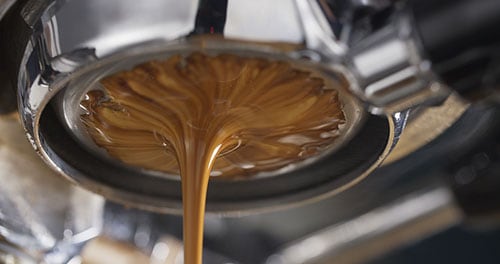
Ask a barista how long an espresso shot should take and you’ll hear “25 to 30 seconds” almost every time. That number is a good place to start, but it only means something when you know what you’re timing, how much coffee went in, and how much came out. Here’s how shot time works and how to use it at home.
How Long Should an Espresso Shot Take to Pull?
The short answer
A standard double espresso should take about 25 to 30 seconds, timed from the moment you start the pump, to turn roughly 18 g of ground coffee into about 36 g of espresso (a 1:2 ratio). Ristrettos run shorter and lungos longer. Treat the time as a check, and let taste make the final call.
- Start the timer when you press the button, not at the first drip.
- Stop the shot by weight, at about twice the dose.
- Under about 20 seconds usually tastes sour; over about 35 usually tastes bitter.
That 25-second figure has deep roots. The traditional Italian standard is a 7 g single that yields about 25 ml in around 25 seconds. Modern cafés mostly pull larger doubles, but the time window stayed roughly the same.
What Happens During a 30-Second Shot
Watch a shot closely, ideally through a bottomless portafilter, and you’ll see it change color as it runs. The early part carries acids and intense flavor, the middle brings sweetness and body, and the tail adds bitterness and dilution:
Water soaks the puck and pressure builds. Pre-infusion makes this stage longer.
Thick, dark beads that join into a stream.
A steady, syrupy, caramel-colored stream. Most of the sweetness lands here.
The stream turns pale and thin. Stop around here, or at your target weight.
The color you see in the cup at the end is mostly crema, which is why weighing the shot beats judging it by volume.
Espresso Shot Time by Drink
Shot time goes hand in hand with ratio, the weight of espresso out compared with the weight of coffee in. These are typical starting points for a double basket:
| Shot | Ratio | Example (18 g dose) | Typical time |
|---|---|---|---|
| Ristretto | About 1:1 to 1:1.5 | 18 g in, 18 to 27 g out | 15 to 25 s (stopped early, or ground finer to keep the time) |
| Espresso (double) | About 1:2 | 18 g in, 36 g out | 25 to 30 s |
| Longer espresso (light roasts) | About 1:2.5 | 18 g in, 45 g out | 28 to 35 s |
| Lungo | About 1:3 or more | 18 g in, 54 g out or more | 30 to 45 s |
| Single shot | About 1:2 | 7 to 9 g in, 14 to 18 g out | 20 to 30 s |
Times are counted from starting the pump. Grind sets the time; the scale sets the ratio.
A ristretto stops early and tastes sweeter and heavier; a lungo runs long and tastes thinner and more bitter. Our guide to ristretto vs espresso vs lungo compares them in the cup. Singles are harder to dial in than doubles, which is one reason most home baristas pull doubles and split them.
Shot Time Is a Guide, Not the Goal

Time is useful because it tells you whether your grind is in the right neighborhood. But two shots that both run 28 seconds can taste completely different, and a shot that runs 33 seconds can taste better than one that hits 27. Taste decides. Time just tells you which way to adjust.
- Light roasts are denser and harder to extract. They often taste best at a longer ratio, around 1:2.5, and a few seconds longer.
- Dark roasts extract easily and can turn bitter fast. A shorter ratio and a slightly faster shot often taste sweeter.
- Pre-infusion adds seconds at the start without adding extraction, so machines with long pre-infusion often run past 30 seconds and taste fine.
- Fast “turbo” shots use a coarser grind, lower pressure and a longer ratio to finish in 15 seconds or so. They’re a deliberate style, not a mistake, but they need a machine that can control pressure or flow.
What a Fast or Slow Shot Tells You
If your shot runs well under 20 seconds, water is passing through the coffee too easily. The shot usually tastes sour and thin, and the fix is a finer grind or, if the basket has room, a slightly bigger dose. If it runs well past 35 seconds or barely drips, the puck is too tight. Expect bitter, dry espresso, and grind coarser. A shot that hits the right time but spurts or tastes sour and bitter at once is usually channeling, which better puck prep and a WDT tool fix.
For every symptom and fix in order, see our espresso troubleshooting guide. If you’re new to espresso altogether, start with what espresso is and how it’s made, and see the step-by-step home shot in our National Espresso Day guide.
Shot Time on Different Machines
- Semi-automatic: you start and stop the shot, so time and weight are fully in your hands. This is where the 25 to 30 second rule is most useful.
- Volumetric buttons: the machine stops after a set amount of water. Weigh a few shots to check what the button actually delivers, then adjust the grind for time.
- Super-automatic: the machine grinds, doses and stops for you. If shots taste sour or bitter, change the grinder setting one step at a time.
- Pod and capsule machines: the capsule fixes the grind and dose, so there’s little to adjust beyond cup size.
- Manual lever: pressure rises and falls with the lever, and shots often include a long pre-infusion, so total time can run longer than on a pump machine.
Whatever the machine, a small coffee scale with a timer under the cup makes shot time and ratio easy to track. If you’re still choosing a machine, see our picks for the best home espresso machines.
Common Shot Timing Mistakes
That trims 5 to 10 seconds off the count and makes a fast shot look right. Start when the pump starts, and do it the same way every time.
A 28-second shot means little if you don’t know whether it yielded 25 g or 50 g. Time and weight belong together.
If a 32-second shot tastes great, it’s a great shot. Adjust for flavor, and use time to stay consistent.
Move the grind and keep the dose fixed. Change one variable per shot so you know what made the difference.
Once you’ve pulled it, drink it soon: here’s how long an espresso shot lasts before the flavor fades.
Former roastery owner and coffee tour operator. Steve spent five years roasting coffee for his own shop and wholesale customers. More about Steve